
Contents
The Point of a KPI
A KPI isn't a number you report. It's a number that tells you whether the work is moving the business forward. If you can hit the number and the client still isn't growing, it's the wrong KPI.
Before you pick a metric or a threshold, ask three questions:
- What does this client actually care about at the business level?
- What are we actually doing — and what can our work reasonably influence?
- Can we measure and report this consistently, with the infrastructure we have today?
If you can't answer all three, you're not ready to set the KPI yet.
The KPI Hierarchy
Not all KPIs live at the same level — and confusing them is one of the most common places this breaks down.
Strategy-level KPIs are the big ones. These tie directly to business outcomes and have quarterly targets attached. Think: MQLs generated, pipeline influenced, revenue attributed to marketing, new contacts by segment. These live in the strategy deck and get reported on monthly.
Campaign-level KPIs are one level down. Each campaign should have one primary KPI — the single most important thing that the campaign is trying to move — plus a supporting set of performance metrics that explain how it's performing. The primary KPI should ladder up to a strategy-level KPI, but it doesn't have to be identical. If the strategy goal is MQLs, a campaign's primary KPI of form submissions from a target audience segment is a completely reasonable one step removed.
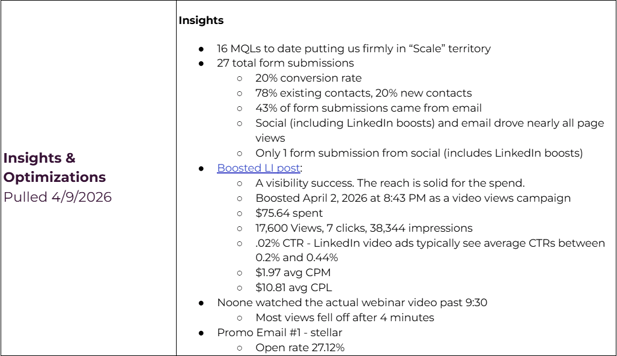
Performance metrics (CTR, CTOR, impression share, engagement rate) are not KPIs. They're diagnostics. They help you understand why a KPI is or isn't moving — they shouldn't be the headline.
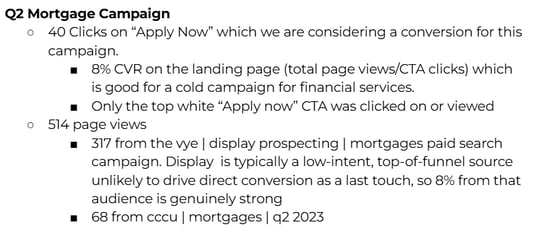
A campaign built around "keywords in top 5" or "increase social followers" isn't built around a KPI. Those are tactics and vanity signals dressed up as goals. More on this below.
Start With the Outcome, Not the Tactic
Work backward from the business outcome:
- What is the client trying to achieve this quarter or year?
- What marketing outcomes connect to that?
- What can our specific tactics influence on the way there?
A good KPI sits at the intersection of what the client cares about and what we can actually move. If we're running a lead gen campaign, the KPI should be MQLs — not impressions, not clicks, not social interactions. Those are tactics. The campaign goal is leads.
A KPI should never be dependent on a single tactic. If the metric disappears the moment one channel is paused, it's a tactic metric — not a strategic one.
Match the Metric to the Moment
Where a client is in their marketing maturity — and where their audience is in the buyer's journey — should shape what you measure.
An awareness campaign and a decision-stage campaign should not share the same KPIs. Awareness might reasonably track new contacts or organic reach. A decision-stage campaign should be tracking conversions, MQLs, or pipeline influenced. Holding an awareness campaign to a revenue standard sets it up to look like it failed. Holding a bottom-funnel campaign to an engagement standard lets it hide.
Ask: what does success look like at this stage, for this client, right now?
The Vanity Metric Problem
Some metrics feel important because they're big numbers. They're not.
Impressions, follower counts, open rates, CTR in isolation, social interactions — these are context, not outcomes. They can support a story but they shouldn't be the headline. If a client asks "how are we doing?" and your honest answer is "our impressions were up 40%" — that's a problem.
A few specific ones worth calling out:
Open rates aren't reliable since Apple Mail Privacy Protection. Use click-to-open rate (CTOR) instead if you need an email engagement signal.
CTR tells you people clicked. It doesn't tell you they did anything meaningful after. Always pair it with a conversion metric.
ROAS is commonly left off campaign KPIs because it requires revenue data the client hasn't connected — but if we're running paid, we should be pushing to get it. A campaign that looks great on CTR and terrible on ROAS is a campaign that isn't working. If we genuinely can't get revenue data, name that gap explicitly and use the best available proxy — don't just default to a metric that makes the campaign look good.
"Keywords in top 5" is not a campaign KPI. It's a lagging SEO signal that depends on algorithm behavior, competition, and time — none of which we fully control. It can be a supporting indicator in an organic search campaign, but it should never be the primary measure of success.
A note on web sessions. Sessions feel safe, but they're unreliable as a primary KPI. Privacy laws and cookie consent banners mean GA4 is already undercounting. Paid traffic inflates the number without reflecting quality. And direct traffic — which catches everything from branded searches to logged-in users to unattributable referrals — skews the baseline. Use sessions as context, not a headline metric.
The rule: if you can hit the KPI and the client's business isn't better for it, it's the wrong KPI.
Before You Commit: Make Sure It's Reportable
This is where good intentions fall apart. A KPI is only as useful as your ability to actually pull the number — consistently, cleanly, and without heroics every month.
Before you finalize any KPI, work through this:
- Is the data in a system we have access to? Don't build a KPI around average order value, closed revenue, or sales cycle length if the client's CRM isn't connected and there's no integration in place. "The client will send us a spreadsheet" is not a reporting infrastructure.
- Have you seen a sample of that data? If a client says they can share revenue numbers, ask to see a sample before you commit. Messy, inconsistent, or incomplete spreadsheets are common — and cleaning them every month is a tax no one budgeted for.
- Are the HubSpot properties and lifecycle stages set up? If you're promising MQL reporting and lifecycle stages aren't configured, that number doesn't exist yet. Make sure the infrastructure is built before the KPI is agreed upon.
- Can you build the report today? If you can't open HubSpot and pull the number right now, ask yourself why — and fix that before the KPI is finalized.
- Is the dimension you need actually tracked? "New contacts from organic" requires source tracking to be clean. "Pipeline from paid" requires ad attribution to be connected. Don't assume it's there — verify it.
Need help with reporting? Ask an Architect!
Architects can help you determine whether a KPI is reportable, build the reports you need, or identify what infrastructure needs to be in place first. If you're unsure whether something can be measured, that's the right question to bring to them before the KPI is finalized — not after.
If a KPI fails any of these checks, either fix the infrastructure first or choose a KPI you can actually measure. Promising a number you can't pull is worse than setting a more conservative KPI you can report on confidently.
Don't Leave It Blank — Take a Guess and Flag It
When you don't have historical data, it's tempting to leave a KPI threshold open or write TBD. Don't. A blank KPI isn't humble — it's just not useful to anyone.
Put a number down. Use benchmarks, use AI, use your best judgment — and then note your confidence level. Something like "estimated based on industry benchmarks, to be refined after 60 days of data" is completely acceptable. It sets an expectation, gives the team something to work toward, and creates a natural checkpoint to revisit.
The first 60–90 days on a new account are often about establishing a baseline. That's fine — say that explicitly. What's not fine is going into a quarterly review with no target to evaluate against.
Don't forget! Set a reminder to revisit. Before you move on, create a task to reassess the benchmark at the 60–90 day mark. An estimated KPI should never accidentally become a permanent one — build the reset into the plan from the start.
Setting Thresholds: How to Think About It
Once you know what you're measuring, you need to decide what "good" looks like. Here's how to build that number:
Start with AI. Use Claude to pull industry benchmarks for the client's vertical, business size, and channel mix. Be specific in your prompt — "what is a reasonable MQL volume for a mid-market B2B manufacturing company running inbound marketing with a 60-day sales cycle?" gets you a much more useful answer than "what's a good MQL target." You'll get a range, not a guarantee, but it gives you a defensible starting point.
Factor in what's real for this specific client:
- Where are they starting from? Zero momentum and an established brand are not the same starting point.
- What's their sales cycle length? A 90-day cycle means a 30-day campaign KPI on revenue won't tell you much.
- Are we launching into their peak season or their slowest month?
- What geography are they in, and does that affect demand? A construction company in Minnesota and a pharmacy in South Florida have fundamentally different seasonal patterns, competitive landscapes, and audience behaviors. Don't apply a national benchmark blindly to a regional business.
The Strong/Weak KPI Reference
Use this as a gut check when building out KPIs for a campaign or strategy. These are patterns, not rules — context always matters, but these mismatches show up repeatedly.
| Play / Campaign Type | Weak KPI | Why It's Weak | Better KPI |
|---|---|---|---|
| Lead gen campaign (paid + content) | CTR | Measures clicks, not leads | MQLs generated |
| SEO / organic content campaign | Keywords in top 5 | We don't control the algorithm | Organic sessions to target pages, contact form submissions from organic |
| Email nurture sequence | Open rate | Unreliable post-Apple Mail; doesn't indicate intent | CTOR, conversion rate, MQLs from sequence |
| Awareness / top-of-funnel campaign | MQLs or pipeline | Too far down the funnel for this stage | New contacts, branded search volume |
| Paid social campaign | Impressions, likes | Vanity — doesn't connect to business outcome | Lead form submissions, cost per lead, pipeline influenced |
| Trade show / event campaign | Booth traffic | Not measurable or reportable from our side | Net new contacts entered into HubSpot post-event, follow-up sequence conversion rate |
| Bottom-funnel / decision-stage campaign | Social engagement | Wrong stage, wrong signal | Demo requests, free trial signups, sales-accepted leads |
| Paid search (ecommerce) | CTR | Doesn't reflect revenue efficiency | ROAS, cost per acquisition |
| Brand awareness campaign | Website sessions | Too broad, too many variables | Direct traffic lift, branded search volume, new visitor rate |
Client Case Study: PURIS Strategy KPIs
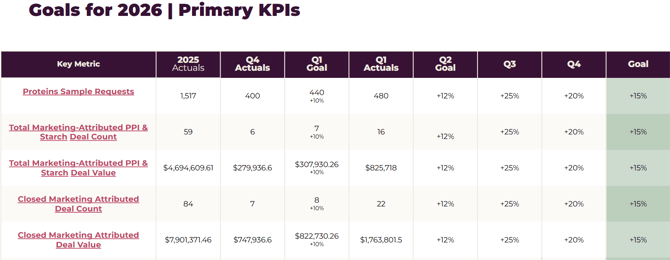
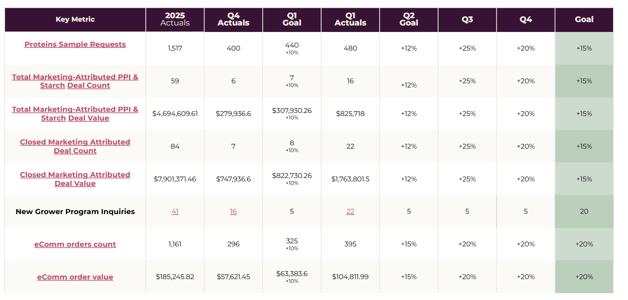
They tied every KPI to a business outcome. Sample requests, deal count, deal value, closed revenue — these are numbers the sales team and leadership recognize, not marketing vanity metrics.
They track both pipeline and closed revenue. Marketing-attributed deal count and deal value show influence on the pipeline. Closed marketing-attributed deal count and value show what actually converted. Both matter and neither replaces the other.
They set targets that scale, not just flat numbers. Rather than picking an arbitrary number for every quarter, they anchored Q1 to a concrete target (+10% over Q4 actuals) and used percentage growth targets from there. This is a clean way to set ambitious but defensible benchmarks when you have historical data to work from.
Client Case Study: Safebuilt — Faster Permits Webinar Campaign
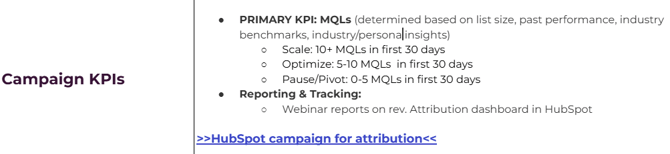
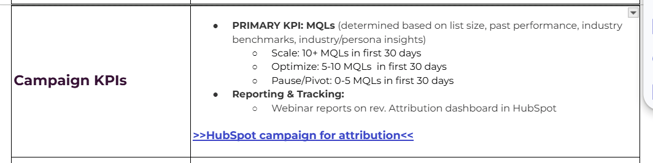
The primary KPI is an outcome, not an activity. MQLs — not registrations, not attendees, not email opens. The goal of the webinar was to generate qualified leads, and that's exactly what's being measured.
The threshold was set with context. The MQL target wasn't pulled from thin air — it was determined based on list size, past performance, industry benchmarks, and persona insights. That's the process.
They built a decision framework into the KPI itself. Rather than just setting a target, they defined what they'd do at each performance level — scale, optimize, or pause. This turns the KPI from a report card into a management tool.
Reporting was planned before the campaign launched. Webinar performance is tracked via the revenue attribution dashboard in HubSpot, and the HubSpot campaign was linked in the brief. The infrastructure was in place before anyone hit send.
A Few Guardrails Before You Finalize
Run every KPI set through these before it goes into a brief or a strategy deck:
- Is it tied to a business outcome? Not a marketing action — an outcome the client's leadership would recognize as meaningful.
- Is it SMART? Specific, Measurable, Actionable, Relevant. Time-bound.
- Is it measurable and reportable today? If you can't pull it from HubSpot, GA4, or an ads platform right now, fix that first.
- Does it match the stage? Awareness, consideration, and decision metrics are different. Don't mix them without intention.
- Is it dependent on one tactic? If yes, reconsider.
- Does it account for this client's specific context — their geography, their seasonality, their sales cycle?
- Would hitting it actually mean something? If the answer is "yes but..." — keep going until the "but" is gone.
Resources
- KPIs for Sales and Marketing to Track (HubSpot Knowledge Article)
- Competitive Benchmarking (HubSpot Knowledge Article)
- HubSpot Business Stats Data Directory (Pillar Page with links to more detailed group of insights and data)
- 7,000 Businesses Benchmarks (HubSpot Gated Offer)