
What Is a Campaign Brief?
A campaign brief is the single source of truth for a campaign before any work begins. It aligns the full team — AM, Strategist, SME, and PM — on what we're building, who it's for, and how we'll measure success.
Every campaign needs a brief. The level of detail should match the complexity of the work, which is why we have three tiers.
What Qualifies as a Campaign?
A campaign is a coordinated set of multi-channel tactics unified around a single objective with a SMART goal.
If it doesn't have a defined goal, a measurable outcome, and more than one tactic working together — it's not a campaign, it's a tactic.
Confused about "tactics" vs "assets"?
A tactic is the what you're doing — the channel or method you're deploying as part of a campaign. Email nurture, paid search, social media. It's a strategic choice that has a role in moving someone through the funnel.
An asset is the thing you make to execute the tactic. The email itself, the landing page, the ad creative, the slide deck. Assets live inside tactics.
So a tactic without an asset is just a plan.
An asset without a tactic is just a deliverable. Together they're execution.
Campaigns are determined during the strategy build and refined in quarterly planning. All campaigns with tactics or reporting in HubSpot should be assigned to a HubSpot campaign. See [link to HubSpot Campaigns KB] for how that works.
For more about campaigns and HubSpot Campaigns, check out our other article "HubSpot Campaigns: What They Are and How We Use Them"
Which Brief Template Do I Use?
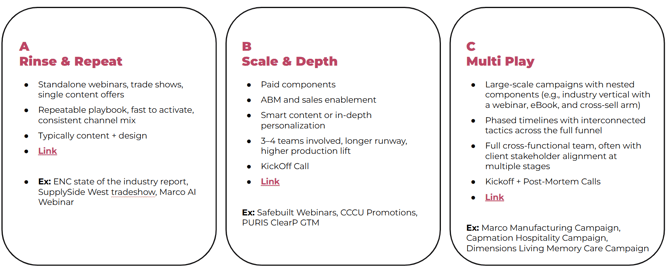
We have three templates. 90% of the work we do will use Template A or B.
Template A — Rinse & Repeat [LINK] Simplest campaigns. Quick plays that are mostly repeatable with a consistent channel mix. Typically content and design only. Examples: standalone webinars, trade shows, single content offers
Template B — Scale & Depth [LINK] More complex campaigns. May involve paid media, ABM, sales enablement, or smart content. Usually 3–4 teams involved with a longer runway and higher production lift. Includes a kick-off call. Examples: Safebuilt Webinars, CCCU Promotions, PURIS ClearP GTM
Template C — Multi Play [LINK] Reserved for large-scale campaigns with nested components — a larger narrative with smaller campaigns living within it. Phased timelines, cross-functional teams, often with client stakeholder alignment at multiple stages. Includes kick-off and post-mortem calls. Examples: Marco Manufacturing Campaign, Capmation Hospitality Campaign, Dimensions Living Memory Care Campaign
Templates may have more sections than your campaign needs. Remove any components that don't apply — the templates are designed to flex.
Who chooses the template? During quarterly planning, the AM and PM (and sometimes the Strategist) align on the scale of each campaign so the PM can package the right brief template with the campaign's parent task in Teamwork.
What is in the Brief?
Who Owns the Brief?
The AM owns it.
Each section of the brief notes the responsible role for that section. Where you see multiple roles listed (e.g., Strategist > Architect), it means the second role can complete that section if the primary isn't available.
The AM is ultimately responsible for the overall maintenance of the brief throughout the life of the campaign — including updates, pivots, and keeping it current.
How Are Tactics Selected?
Tactics are called out as clearly as possible during strategy so they can be incorporated into the calculator. That said, nuance gets missed — which is exactly what quarterly planning is for. AM, PM, and Strategist use that time to align on scope and finalize tactics.
If adjustments come up before work begins (a recommended add, a client handling something that frees up budget), the AM approves those changes.
After kick-off, scope is locked. This gives PMs time to make final task adjustments before production starts. Anything that changes after kick-off and impacts scope is a pivot.
Strategy sets it → Quarterly planning refines it → Kickoff locks it → Changes after that are pivots.
What Happens When a Campaign Changes?
Significant pivots — anything that affects reporting, attribution, production, or launch — must be reflected in the brief. Minor asset edits and notes after IR are not pivots and don't require a brief update.
If a campaign grows or shrinks in scope, the brief templates are built so you can add or remove sections rather than starting over with a new template.
All pivots should be communicated in the client's Slack channel with relevant parties tagged.
Kick-Offs and Post-Mortems
Template B and C campaigns have kick-off calls, scheduled by the PM. This is the time for the team to align on objectives, ask questions, and discuss priorities before work begins.
Post-mortems are required for all Template C (Tier 3) campaigns.
When Do We Start Using These?
New brief templates are in effect for all new campaigns as of May 5, 2026. Campaigns already in-flight will continue using the previous template — no need to re-do existing documentation.
Questions or Feedback?
We'll be revisiting this process regularly. Bring any feedback directly to Gracie.